HolisticA
Root-Cause Medicine
Chronic Fatigue: Understand the 13 Primary Drivers
NEW HERE? START WITH THE PREVIEW:
Watch 10-minute Video: What This Page Offers to You
CHRONIC FATIGUE: THE DEEP DIVE PATH
1. FULL 105-MINUTE MEDICAL DEEP DIVE
(ALL 13 DRIVERS & LAB TESTS)
2. SHORT ON TIME? WATCH
CONDENSED 20-MINUTE VIDEO
(LAB TESTS ONLY)
3. FOR YOUR REFERENCE
(LAB TESTS ONLY)
Quiz Identifying the Primary Drivers of Your Chronic Fatigue:
Driver 1 - Mitochondrial Breakdown (Energy Production)
Driver 2 - HPA Axis Collapse (Stress Response)
Driver 3 - Dysbiosis & Leaky Gut
Driver 4 - Nutrient Deficiency
Driver 5 - Toxic Burden
Driver 6 - Infection & Immune Problems
Driver 7 - Sleep & Circadian Rhythm Disorder
Driver 8 - Methylation Imbalance
Driver 9 - Low-Grade Inflammation
Driver 10 - Neurotransmitter Imbalance
Driver 11 - Neuroinflammation
Driver 12 - Autonomic Nervous System Imbalance (Dysautonomia)
Driver 13 - Oral Infection
1. Mitochondrial Breakdown:
2. HPA Axis Collapse:
3. Dysbiosis & Leaky Gut:
4. Nutrient Deficiency:
5. Toxic Burden:
6. Infection & Immune Problems:
7. Sleep & Circadian Rhythm Disorder:
8. Methylation Imbalance:
9. Low-Grade Inflammation:
10. Neurotransmitter Imbalance:
11. Neuroinflammation:
12. Autonomic Nervous System Imbalance:
13. Oral Infection:
Take a screenshot of the quiz results for your records.
(Optional) Receive the FREE Chronic Fatigue Starter Kit:
(This highly interactive kit has exercises you can do at home for free and narrow down the list of drivers affecting you from 13 drivers down to 2-4 drivers. That makes lab testing more affordable.)
Heading 3
5 Archetypical Profiles of Chronic Fatigue
The Wired Sleeper
Description
-
HPA axis dysregulation + cortisol collapse.
-
Stuck in a loop of core exhaustion and insomnia.
-
Feels “tired and wired” – unable to rest and constantly fatigued
Behavioral Patterns:
-
Pushes through exhaustion
-
Overcommits, difficulty slowing down
-
Uses productivity to cope with stress
-
Relies on caffeine or stimulation to function
Stress Patterns:
-
Hypervigilant, easily startled
-
Stress spikes at night instead of morning
-
Feels “on edge” even when nothing is wrong
-
Stress recovery is slow
Sleep Patterns:
-
Difficulty falling asleep despite exhaustion
-
Nighttime alertness (“second wind”)
-
Light, fragmented sleep
-
Wakes unrefreshed
Cognitive Patterns:
-
Racing thoughts at night
-
Difficulty shutting off mental loops
-
Morning brain fog
-
Afternoon crashes with evening alertness
Likely Drivers:
-
Strong Likelihood: Driver 2 - HPA Axis Dysregulation, Driver 12 - Autonomic Nervous System Imbalance, Driver 7 - Sleep & Circadian Rhythm Disorder
-
Moderate Likelihood: Driver 10 - Neurotransmitter Imbalance, Driver 9 - Low-Grade Inflammation
-
Small Likelihood: Driver 1 - Mitochondrial Breakdown, Driver 4 - Nutrient Deficiency


The Foggy Thinker
Description
-
Mitochondrial collapse + neuroinflammation
-
Struggles with memory, focus, and motivation
-
Feels like their brain is wrapped in cotton
Behavioral Patterns:
-
Avoids mentally demanding tasks
-
Needs frequent breaks
-
Withdraws socially due to cognitive fatigue
-
Slower task initiation
Stress Patterns:
-
Stress worsens brain fog
-
Overwhelm triggers shutdown
-
Difficulty multitasking under pressure
-
Feels mentally “fragile”
Sleep Patterns:
-
Sleep may be long but not restorative
-
Wakes groggy
-
Brain fog persists regardless of sleep duration
-
Sensitive to sleep deprivation
Cognitive Patterns:
-
Slow processing speed
-
Poor recall
-
Difficulty finding words
-
Feels like thinking through cotton
Likely Drivers:
-
Strong Likelihood: Driver 1 - Mitochondrial Breakdown, Driver 11 - Neuroinflammation
-
Moderate Likelihood: Driver 10 - Neurotransmitter Imbalance, Driver 9 - Low-Grade Inflammation
-
Small Likelihood: Driver 3 - Dysbiosis & Leaky Gut, Driver 7 - Sleep & Circadian Rhythm Disorder
The Detox Blocker
Description
-
Mycotoxin overload + sluggish detox pathways
-
Sensitive to smells, chemicals, and environments
-
Feels like their body is holding onto invisible toxins
Behavioral Patterns:
-
Avoids chemical exposures
-
Sensitive to fragrances, cleaners, smoke
-
Easily overwhelmed by environments
-
Prefers controlled, predictable settings
Stress Patterns:
-
Stress worsens chemical sensitivity
-
Emotional flatness during overload
-
Irritability when detox pathways are strained
-
Difficulty bouncing back from stressors
Sleep Patterns:
-
Sleep may be shallow
-
Wakes feeling “toxic” or heavy
-
Night sweats or headaches
-
Sleep disrupted by environmental triggers
Cognitive Patterns:
-
Head pressure
-
Slowed thinking
-
Difficulty concentrating in certain environments
-
Emotional blunting
Likely Drivers:
-
Strong Likelihood: Driver 5 - Toxic Burden, Driver 8 - Methylation Imbalance
-
Moderate Likelihood: Driver 1 - Mitochondrial Breakdown, Driver 9 - Low-Grade Inflammation
-
Small Likelihood: Driver 6 - Infection & Immune Problems, Driver 4 - Nutrient Deficiency

The Gut Derailed Reactor
Description
-
Dysbiosis + malabsorption
-
Experiences bloating, food sensitivities, and post-meal crashes
-
Feels like their gut is sabotaging their energy
Behavioral Patterns:
-
Avoids eating out due to reactions
-
Hyper-aware of food triggers
-
Cycles through diets trying to feel better
-
Hesitant to try new foods
Stress Patterns:
-
Stress worsens gut symptoms
-
Gut flares trigger emotional swings
-
Stress-induced appetite changes
-
Feels unsafe in unpredictable environments
Sleep Patterns:
-
Sleep disrupted by bloating or discomfort
-
Fatigue after meals affects sleep timing
-
Nighttime waking after late meals
-
Morning sluggishness
Cognitive Patterns:
-
Post-meal brain fog
-
Mood swings tied to gut symptoms
-
Difficulty focusing when bloated
-
Irritability after food reactions
Likely Drivers:
-
Strong Likelihood: Driver 3 - Dysbiosis & Leaky Gut, Driver 4 - Nutrient Deficiency
-
Moderate Likelihood: Driver 9 - Low-Grade Inflammation, Driver 10 - Neurotransmitter Imbalance
-
Small Likelihood: Driver 1 - Mitochondrial Breakdown, Driver 7 - Sleep & Circadian Rhythm Disorder

The Nutrient Starved Achiever
Description
-
Micronutrient depletion + poor absorption
-
Eats well, supplements often, but still feels depleted
-
Feels like their cells are starving despite effort
Behavioral Patterns:
-
High achiever, pushes through fatigue
-
Overworks despite symptoms
-
Supplements heavily but inconsistently
-
Perfectionistic tendencies
Stress Patterns:
-
Stress rapidly drains energy
-
Symptoms worsen during busy periods
-
Feels depleted after fasting or skipping meals
-
Stress triggers muscle tension and cramps
Sleep Patterns:
-
Light sleep
-
Wakes early and can’t fall back asleep
-
Fatigue persists despite “good sleep hygiene”
-
Sleep worsens during nutrient lows
Cognitive Patterns:
-
Difficulty sustaining focus
-
Mental fatigue during long tasks
-
Feels mentally “underpowered”
-
Trouble with memory recall under stress
Likely Drivers:
-
Strong Likelihood: Driver 4 - Nutrient Deficiency, Driver 3 - Dysbiosis & Leaky Gut
-
Moderate Likelihood: Driver 1 - Mitochondrial Breakdown, Driver 8 - Methylation Imbalance
-
Small Likelihood: Driver 2 - HPA Axis Dysregulation, Driver 9 - Low‑Grade Inflammation

The 13 Known Primary Drivers of Chronic Fatigue:

1: Mitochondrial Breakdown
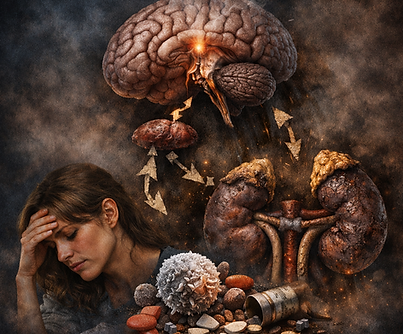
Your mitochondria are the microscopic "power plants" inside your cells. They take the food you eat and the oxygen you breathe and turn them into ATP, the universal energy currency of the human body. When these power plants are damaged by toxins, infections, or poor nutrition, your "cellular battery" simply refuses to hold a charge.
Interesting Facts:
-
The ATP Crisis: A healthy person produces their own body weight in ATP every day; when mitochondria fail, you are quite literally operating on a "low battery" mode at a cellular level.
-
Efficiency Loss: Damaged mitochondria leak electrons, creating oxidative stress that further damages the cell, creating a vicious cycle of increasing exhaustion.
-
Tissue Demand: Your heart and brain have the highest concentration of mitochondria; this is why "brain fog" and physical lethargy usually happen at the exact same time.
2: HPA Axis Collapse
Often mislabeled as "adrenal fatigue," this is actually a communication glitch between your brain (Hypothalamus and Pituitary) and your adrenals. It’s like a thermostat that’s broken; your brain is screaming for energy, but the message isn't getting through, or the adrenals are too exhausted to respond. This leads to that "tired but wired" feeling at 2:00 AM.
Interesting Facts:
-
The Cortisol Slump: Instead of a morning "spike" to wake you up, dysregulation often causes a flat cortisol curve, making it feel impossible to get out of bed without caffeine.
-
The Wired-at-Night Phenom: When the HPA axis is "flipped," your body may produce a surge of cortisol at night, preventing deep, restorative sleep and ensuring you wake up tired the next day.

3: Dysbiosis & Leaky Gut
Your gut is the gatekeeper of your health. Dysbiosis is an imbalance where "bad" bacteria or yeast take over the "good" neighborhood. This leads to "Leaky Gut" (intestinal permeability), where the tight junctions of your gut wall loosen, allowing undigested food and toxins to "leak" into your bloodstream, triggering a massive immune flare-up.
Interesting Facts:
-
Endotoxin Drainage: When the gut is "leaky," bacterial toxins called LPS enter the blood; the liver must use massive amounts of energy to clear these, leaving little left for you.
-
The Sickness Response: A "leaky" gut triggers a systemic immune response; your brain interprets this as being "sick," which is why you feel the urge to lie down even if you aren't "ill."

4: Nutrient Deficiency
You can be "overfed but undernourished." Chronic illness increases your body’s demand for specific vitamins and minerals, while digestive issues often prevent you from absorbing them. Without the right "raw materials"—like B-vitamins, Magnesium, and Zinc—your metabolic machinery simply grinds to a halt.
Interesting Facts:
-
The B-Vitamin Spark: B-vitamins act as "co-factors" that turn food into fuel. Without them, the assembly line of energy production simply stops, no matter how much you eat.
-
The Magnesium Burn: Magnesium is needed for every single molecule of ATP to be biologically active. If you are low on magnesium, the energy you do make can't be used by your muscles or brain.

5: Toxic Burden
We are the first generation in history to be born with a "body burden" of hundreds of industrial chemicals. When your liver, kidneys, and lymphatic system can’t keep up with the influx of heavy metals, pesticides, and plastics, these toxins "clog" your enzymes and interfere with hormone signaling.
Interesting Facts:
-
Metabolic Friction: Heavy metals like lead or mercury can physically block the enzymes that produce energy, acting like "sand in the gears" of your metabolism.
-
Hormone Mimicry: Environmental toxins can mimic hormones like estrogen or thyroid, confusing your body's energy-signaling system and causing "unexplained" fatigue.

6: Infection & Immune Problems
Sometimes the "flu" never really leaves. Chronic, low-grade infections—like Epstein-Barr Virus (EBV), Lyme, or Mold—act like a background program on a computer that’s using up all the RAM. Your immune system stays in a permanent state of "sickness behavior," diverting all your energy toward a war that never ends.
Interesting Facts:
-
Energy Sequestration: The immune system is the most "expensive" system to run. When it’s fighting a chronic infection, it "borrows" energy from your muscles and brain to fuel the fight.
-
Mitochondrial Hijacking: Many viruses and bacteria actually "steal" nutrients and energy directly from your mitochondria to help themselves replicate, leaving you drained.

7: Sleep & Circadian Rhythm Disorder
Sleep is not just "down time"; it is the only time your body performs deep cellular repair. If your circadian rhythm (your internal 24-hour clock) is disrupted, your body fails to produce the growth hormones and melatonin needed to "reset" your system for the next day.
Interesting Facts:
-
The Glymphatic Wash: Deep sleep is the only time your brain "washes" out metabolic waste; if this doesn't happen, you wake up with "chemical brain fog" that feels like a hangover.
-
Melatonin’s Secret Role: Beyond sleep, melatonin is a master mitochondrial antioxidant. Low melatonin means your "power plants" get damaged overnight instead of being repaired.

8: Methylation Imbalance
Methylation is a fundamental chemical process—adding a "methyl group" to a molecule—that acts as the master "on/off switch" for your DNA. It controls how you detox, how you make neurotransmitters, and how you repair your cells. If your methylation is sluggish (often due to the MTHFR gene), your whole system starts to lag.
Interesting Facts:
-
Neurotransmitter Drain: Methylation is required to make CoQ10 and Carnitine—two essential nutrients that shuttle fuel into your mitochondria for energy.
-
The Detox Lag: Poor methylation leads to a buildup of homocysteine, a "toxic" byproduct that causes inflammation and directly contributes to feelings of lethargy and malaise.

9: Low-Grade Inflammation
Inflammation is your body's "fire department," but chronic inflammation is like a fire that won't go out. Even if you don't have a swollen joint or a fever, "sterile" inflammation in the background consumes massive amounts of energy and tells the brain to stay in a state of exhaustion.
Interesting Facts:
-
Cytokine-Induced Fatigue: Inflammatory molecules (cytokines) travel to the brain and signal the "off" switch for physical activity to preserve energy for "healing."
-
Insulin Resistance: Chronic inflammation makes your cells "deaf" to insulin, meaning the sugar in your blood can't get into your cells to be burned for energy.

10: Neurotransmitter Imbalance
Your brain uses chemical messengers called neurotransmitters to tell you to "go" (dopamine), "relax" (GABA), or "be happy" (serotonin). When these are out of balance—often due to gut issues or chronic stress—you experience "brain fatigue," lack of motivation, and poor focus.
Interesting Facts:
-
The Dopamine Deficit: Dopamine is the molecule of "anticipation" and drive. When it’s low, even simple tasks feel like climbing a mountain, leading to "mental fatigue."
-
Serotonin-Melatonin Bridge: Since serotonin is the precursor to melatonin, an imbalance here ensures you are both unhappy during the day and exhausted at night.

11: Neuroinflammation
Neuroinflammation is quite literally "brain on fire." Inside your brain are immune cells called microglia. Normally they are quiet, but if they get "activated" by toxins or infections, they release inflammatory chemicals that slow down the speed at which your brain cells communicate.
Interesting Facts:
-
The Slow-Down Effect: Neuroinflammation slows down the speed at which neurons fire; this manifests as "cognitive fatigue," where thinking feels like wading through thick mud.
-
Glutamate Toxicity: Inflammation causes a buildup of glutamate, an "exciting" chemical that overstimulates brain cells until they become exhausted and "burn out."

12: Autonomic Nervous System (ANS) Imbalance
Your ANS is the "autopilot" of your body, controlling your heart rate, breathing, and digestion. It has two modes: Sympathetic (Fight or Flight) and Parasympathetic (Rest and Digest). Chronic illness often keeps you stuck in "Fight or Flight," meaning your body is constantly burning high-octane fuel even when you're lying in bed.
Interesting Facts:
-
The Engine Idle: Being stuck in "Sympathetic" mode is like idling your car at 5,000 RPMs while it’s parked in the garage; you are burning through your energy reserves for no reason.
-
Poor Recovery: If you can't switch into "Parasympathetic" mode, your body never enters the "repair" state, meaning you never actually recover from the previous day's activities.

13: Oral Infection
The mouth is the gateway to the body. Hidden "cavitations" (holes in the jawbone from old tooth extractions), silent root canal infections, or excess tartar buildup can leak bacteria and toxins directly into your bloodstream and lymphatic system 24/7.
Interesting Facts:
-
The Constant Drain: Your immune system must dedicate a portion of its "energy budget" 24/7 to containing oral bacteria, leaving you with less "spending money" for your daily life.
-
The Pathogen Pipeline: Oral bacteria can travel directly to the heart or brain through the bloodstream, triggering systemic inflammation that keeps you in a state of chronic fatigue.
Myth Busting
Myth 1: Chronic fatigue is just being tired
It’s a multi‑system dysfunction, not ordinary tiredness.
Myth 2: It's all in your head
Fatigue often reflects measurable biological imbalances, not imagination.
Myth 3: If you sleep more, it will go away
Sleep helps, but circadian disruption, mitochondrial issues, or inflammation can persist regardless.
Myth 4: Blood tests are normal, so nothing is wrong
Standard labs often miss subtle dysfunctions like nutrient insufficiency or HPA axis dysregulation.
Myth 5: Chronic fatigue is caused by laziness
People with chronic fatigue often push themselves far beyond their physiological capacity.
Myth 6: Only depression causes chronic fatigue
Mood changes can coexist, but fatigue can stem from immune, gut, mitochondrial, or neurochemical issues.
Myth 7: If you exercise more, you’ll get your energy back
Overexertion can worsen symptoms when mitochondria, inflammation, or autonomic balance are impaired.
Myth 8: Chronic fatigue is the same for everyone
Different root causes create different fatigue patterns—immune‑driven, gut‑driven, hormonal, neurological, etc.
Myth 9: Fatigue is always caused by stress
Stress matters, but so do toxins, infections, nutrient gaps, and gut dysfunction.
Myth 10: If you just eat healthier, the fatigue will disappear
Nutrition helps, but deeper issues like methylation imbalance or neuroinflammation may persist.
Myth 11: Chronic fatigue is rare
It’s extremely common—many people experience persistent fatigue without a clear diagnosis.
Myth 12: You can fix chronic fatigue with supplements alone
Supplements may support physiology, but root causes often require broader lifestyle and environmental changes.
Myth 13: Fatigue means you’re getting older
Age can influence energy, but persistent fatigue is not an inevitable part of aging.
Myth 14: If you don’t look sick, you’re fine
Many root causes—like dysbiosis, inflammation, or neurotransmitter imbalance—are invisible externally.
Myth 15: Chronic fatigue is caused by one single issue
It’s usually multi‑factorial, involving several systems simultaneously.
Myth 16: You can power through fatigue if you try hard enough
Pushing through can worsen mitochondrial strain and autonomic imbalance.
Myth 17: Fatigue is always caused by low iron or anemia
Nutrient deficiency is one cause, but far from the only one.
Myth 18: If you’re fatigued, you must have a thyroid problem
Thyroid issues can contribute, but many people with fatigue have normal thyroid function.
Myth 19: Chronic fatigue is permanent
Many people improve when underlying imbalances are identified and addressed.
Myth 20: Oral health has nothing to do with fatigue
Oral infections can influence inflammation, immune load, and systemic energy levels.
Diet Plan for Chronic Fatigue
These help energy production at the cellular level:
-
Grass‑fed beef (CoQ10, B12, carnitine)
-
Wild salmon, sardines, mackerel (omega‑3s)
-
Eggs (choline, B vitamins)
-
Spinach, kale, chard (magnesium, folate)
-
Beets (nitric oxide supports better oxygen delivery)
-
Avocado (healthy fats + potassium)

Mitochondria Supportive Foods

Anti‑inflammatory foods
Reduce immune activation that drains energy:
-
turmeric + black pepper
-
ginger
-
berries
-
olive oil
-
walnuts
-
leafy greens
-
cruciferous vegetables (broccoli, cauliflower, Brussels sprouts)

Gut‑healing foods
Because chronic fatigue often has a gut‑immune component:
-
bone broth
-
cooked vegetables (easier to digest than raw)
-
sweet potatoes
-
squash
-
coconut yogurt (if dairy‑free)
-
low‑histamine fermented foods (if tolerated)

Blood‑sugar stabilizing foods
Stable glucose supports stable energy:
-
protein with every meal
-
healthy fats (avocado, nuts, seeds, olive oil)
-
slow carbs (quinoa, lentils, chickpeas, oats)
-
fiber‑rich vegetables

Micronutrient-dense foods
Chronic fatigue often involves deficiencies in:
-
B12
-
magnesium
-
iron
-
zinc
-
omega‑3s
-
vitamin D
Food sources:
-
shellfish (zinc, B12)
-
pumpkin seeds (zinc, magnesium)
-
dark chocolate (magnesium)
-
mushrooms (vitamin D precursors)
-
liver (B vitamins, iron) — optional but powerful
Daily Meals
Breakfast
-
2–3 eggs cooked in olive oil or ghee
-
sautéed spinach + mushrooms
-
½ avocado
-
green tea or matcha (gentler caffeine)
Lunch
-
wild salmon or chicken
-
large salad with mixed greens, beets, cucumbers
-
olive oil + lemon dressing
-
quinoa or lentils
Snack
-
handful of walnuts or almonds
-
berries
-
herbal tea (ginger, peppermint, rooibos)
Dinner
-
grass‑fed beef or turkey
-
roasted sweet potatoes
-
steamed broccoli or Brussels sprouts
-
bone broth on the side
Before bed
-
magnesium glycinate–rich foods (pumpkin seeds, leafy greens)
-
chamomile or lemon balm tea
Supplement Add-ons
-
Adaptogens: ashwagandha, rhodiola, holy basil
-
Mitochondrial nutrients: CoQ10, L‑carnitine, alpha‑lipoic acid
-
Gut support: glutamine, zinc carnosine, probiotics
-
Anti‑inflammatory support: curcumin, omega‑3s